
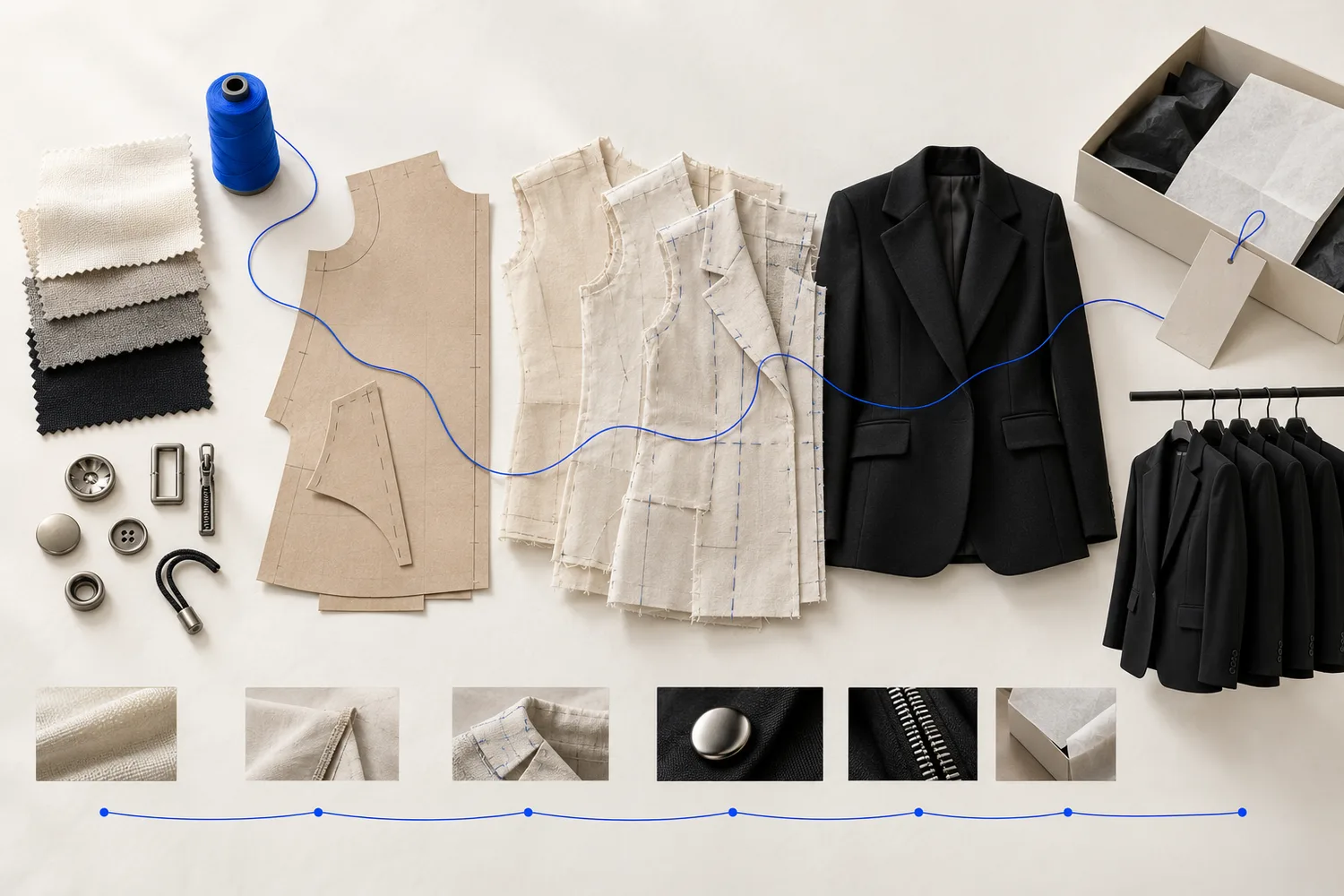
Key takeaways
- Count unique constructions, not only styles.
- Custom materials and components create supplier development cost as well as product cost.
- Every sample round has pattern, material, labour, freight and management cost.
- A cheaper development route can create a more expensive bulk mistake.
Indicative cost to an approved sample
These are broad working ranges for initial budgeting, excluding bulk production, taxes and major tooling. Geography, category and documentation quality can move them substantially.
| Category | Indicative development range per style | Usually included / excluded |
|---|---|---|
| Basic jersey style | €300–900 | Pattern adjustment and 1–2 samples; custom fabric/testing excluded |
| Woven shirt, dress or trouser | €700–1,800 | Pattern, toile/sample and fit rounds; premium material extra |
| Structured outerwear | €1,200–3,500 | Complex pattern and 2–3 rounds; special hardware/testing extra |
| Machine knitwear | €600–2,000 | Programming, swatch and samples; custom yarn MOQ excluded |
| Leather accessory | €700–2,500 | Pattern, prototype and finishing; moulds/hardware tooling extra |
| Footwear | €1,500–5,000+ | Construction, prototypes and fittings; new last/sole tooling excluded |
| Mixed 8-style capsule | Roughly €8,000–25,000 | Depends on shared blocks, categories and rounds; bulk excluded |
The eight main cost drivers
- Number of unique patterns and constructions.
- Readiness of sketches, measurements and tech packs.
- Stock versus custom material and colour.
- Custom hardware, moulds, lasts, soles, prints or embroidery.
- Number and complexity of sample rounds.
- Testing, certification and destination-market requirements.
- Pattern grading and number of sizes validated.
- Project management across suppliers, countries and logistics.
Why style count is misleading
Eight colour variations of one sweatshirt are not eight developments. Four dresses with different constructions may be four full developments. Build the budget from blocks and technical families.
Shared fabric can reduce sourcing and MOQ, but it does not remove separate pattern, fit or workmanship work. Shared trims help only when dimensions and attachment methods are genuinely common.
Sample cost versus development cost
A factory sample invoice may cover only cutting and sewing. Development also includes research, material sourcing, pattern work, comments, fittings, technical files, supplier communication, freight and recosting.
Ask what happens if the first sample fails because the brief was incomplete, because the factory made an error, or because the design changes. Responsibility should not be negotiated after the failure.
How to control the budget
- Approve an assortment architecture before developing every sketch.
- Group styles by shared block, material and supplier.
- Set a maximum number of included sample rounds.
- Freeze critical design decisions before custom components.
- Track development cost separately from bulk unit cost.
- Use a change log showing cost and calendar impact.
- Stop weak styles before grading, testing and packaging.
A simple budgeting example
An eight-style capsule with two jersey styles, two woven styles, two knitwear styles, one outerwear style and one accessory is not one homogeneous project. A sensible early budget separates each technical family, adds material development, freight and a 10–20% contingency for controlled iteration.
The goal is not to spend the minimum on development. It is to spend enough to make the bulk decision predictable.