
Key takeaways
- Ask for MOQ by style, colour and order—not one headline number.
- Stock material can reduce a minimum dramatically; custom colour usually raises it.
- A factory may accept a small order but price it as development or add a surcharge.
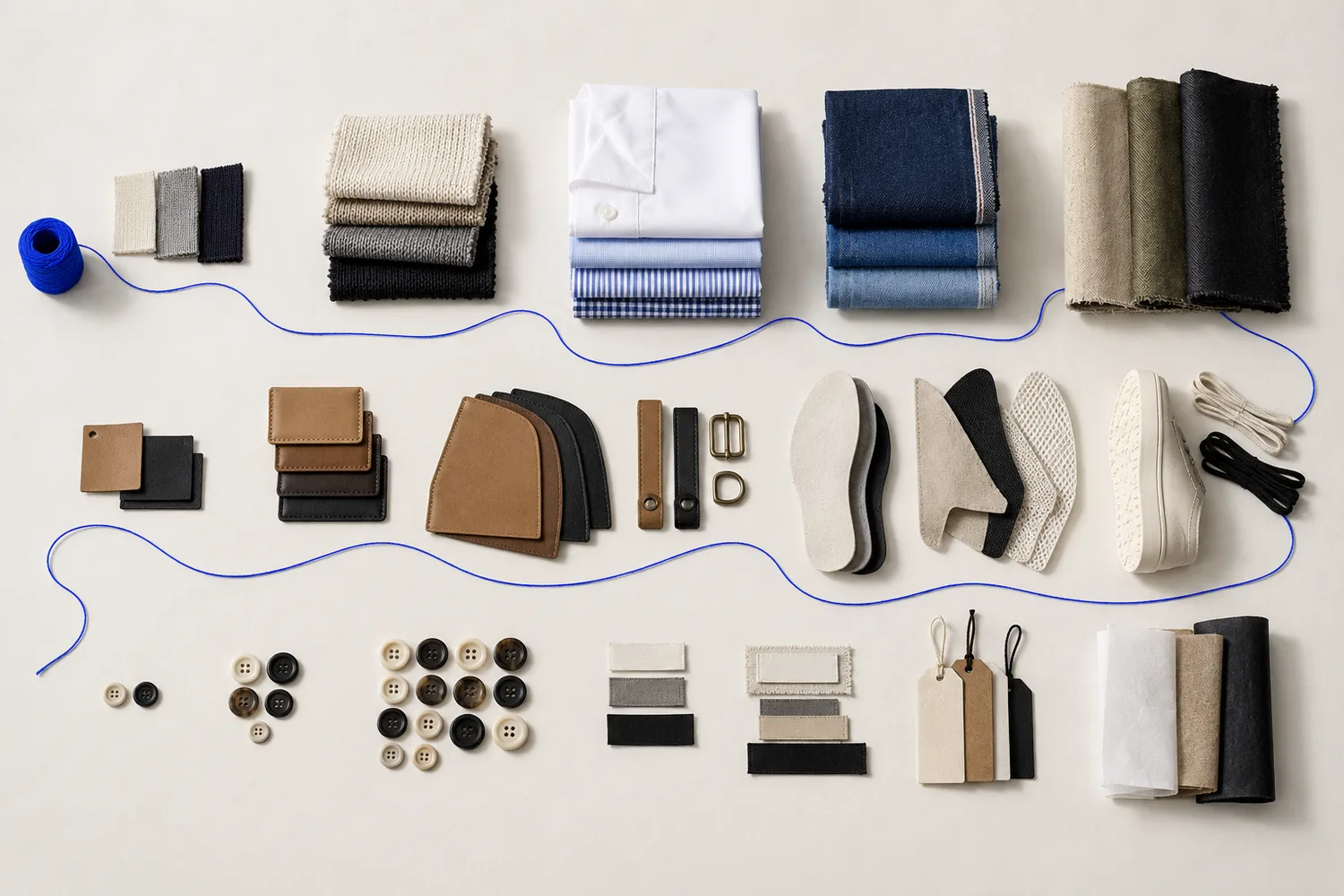
- The true minimum is often set by fabric, yarn, sole or hardware rather than sewing capacity.
Working MOQ ranges
The ranges below are realistic screening numbers for an established production route. They assume a production-ready product and no unusually expensive custom development.
| Category | Low-volume route | More typical production range | What usually sets the minimum |
|---|---|---|---|
| Jersey T-shirts / sweats | 50–100 per style/colour | 100–300 | Fabric colour, rib, printing and cutting marker |
| Woven shirts / dresses / trousers | 50–100 | 100–250 | Fabric MOQ, size ratio and construction time |
| Denim | 75–150 | 150–500 | Denim roll, wash batch and trim development |
| Machine knitwear | 25–60 with stock yarn | 60–150; 100–300 for custom colour | Yarn cone minimum, colour, programming and linking |
| Outerwear | 50–100 | 100–300 | Shell and lining MOQ, insulation, trims and operation count |
| Leather goods | 50–100 | 100–300 | Leather skin yield, hardware and edge-paint setup |
| Footwear | 80–150 per colour | 150–300+ per colour | Sole/last availability, leather, components and size run |
| Scarves / simple textile gifts | 50–100 | 100–500 | Print method, fabric width, finishing and packaging |
Why the same style receives three different minimums
A factory may quote 50 pieces for a style made in black stock fabric, 150 for a mill colour already scheduled, and 500 for a custom weave. All three quotes can be correct.
MOQ needs to be decomposed into four numbers: material minimum, colour minimum, factory minimum and economic minimum. The economic minimum is the quantity below which unit cost becomes commercially irrational.
- Ask whether the minimum is per style, per colour or total order.
- Confirm whether sizes may be mixed inside the minimum.
- Ask how leftover material is charged and stored.
- Check whether repeat orders can use reserved yarn or fabric.
- Separate prototype quantity from bulk MOQ.
How to reduce MOQ without damaging the product
The most effective method is not harder negotiation. It is reducing custom variables. Use stock colours, shared materials across styles, standard hardware and one packaging system.
Combining several styles into one material commitment can work, but only if the mill and factory accept the allocation. Reducing colours usually saves more than reducing sizes.
- Use one base fabric across two or three styles.
- Launch fewer colours and deepen the size curve.
- Choose existing soles, lasts, zips and buttons.
- Pay a documented surcharge instead of producing unwanted stock.
- Plan repeat orders before a material is discontinued.
The number to put in the brief
Give an exact target by style, colour and size ratio, plus an acceptable alternative. Example: 120 units per style across two colours, sizes XS–XL; acceptable route: 150 units if the same fabric is shared across three styles.
Without this structure, suppliers protect themselves with a high minimum or return an attractive quote that cannot survive material booking.