
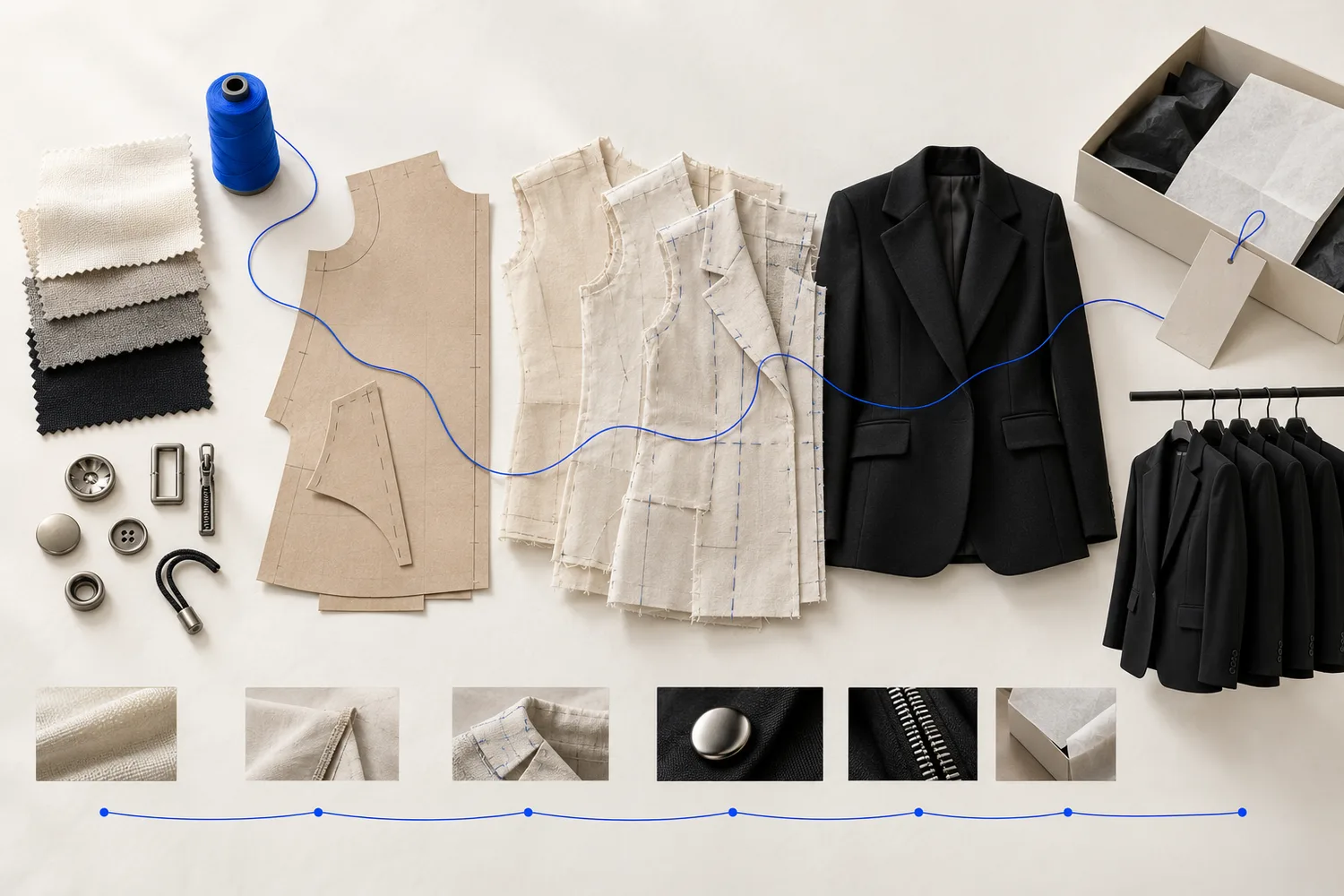
Key takeaways
- Define whether the target is wholesale, DTC or a mixed channel.
- Landed cost includes freight, duty, testing and packaging—not only ex-factory price.
- Material yield and MOQ often move cost more than sewing minutes.
- Keep development and one-off tooling separate from recurring unit cost.
Work backwards from the channel
For a DTC product, test the target retail price against VAT, discounts, returns, fulfilment, payment fees and contribution margin. For wholesale, test the wholesale price and retailer markup. A single multiplier is not a financial model.
Set a landed-cost ceiling before the factory starts development. Without it, the team can approve a beautiful sample that cannot support the intended business.
Cost stack
| Layer | Includes | Common omission |
|---|---|---|
| Materials | Fabric/yarn, lining, trims, labels, waste | Minimum-order surcharge and unusable width |
| Conversion | Cutting, sewing/knitting, washing, finishing | Special operation or low-volume inefficiency |
| Pack | Polybag, box, tissue, barcode, carton | Assembly and kitting labour |
| Landed | Freight, duty, customs, testing, inspection | Express shipment and failed test repeat |
| Development | Patterns, samples, moulds, artwork, lab dips | Amortisation over an unrealistic quantity |
Run three quantities
Calculate at minimum order, expected order and stretch order. This shows whether the product is structurally viable or only works at a volume the sales plan cannot support.
For material-led products, calculate yield from usable width, marker efficiency, shrinkage and defect allowance. For knitwear, calculate kilograms from approved garment weight plus linking, washing and waste.
Approve changes commercially
Every design change after costing should show its cost effect: material consumption, operation time, tooling, failure risk and calendar. Replace vague “make it cheaper” requests with a ranked value-engineering list.