
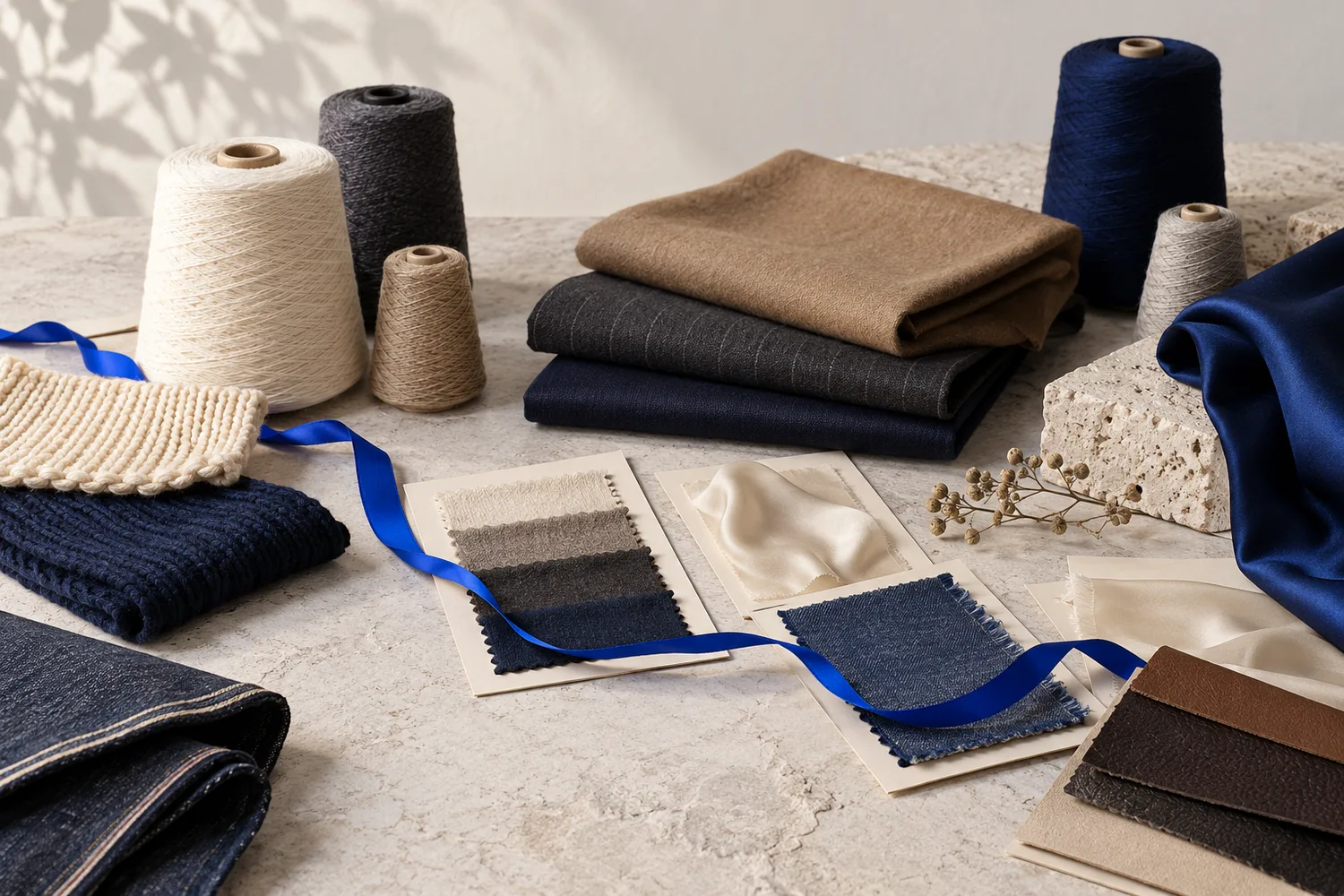
Key takeaways
- Stock service and made-to-order production have different MOQ, price and continuity.
- A sample card does not confirm bulk availability.
- Yarn count, gauge, finishing and factory machinery must be selected together.
- Reserve material against an approved calendar, not only an aesthetic preference.
Typical sourcing routes
There are four practical routes: mill stock service, converter or agent stock, made-to-order mill production and deadstock. Each solves a different problem.
| Route | Indicative minimum | Typical timing | Main trade-off |
|---|---|---|---|
| Fabric stock service | 20–100 metres per colour | 1–3 weeks if physically available | Fast and low minimum; continuity may be limited |
| Converter / agent stock | One roll or 30–100 metres | 1–3 weeks | Access to multiple mills; verify provenance and repeatability |
| Made-to-order fabric | 300–1,000 metres per colour; specialist qualities can differ | 6–12 weeks after lab approval | Control and continuity; higher commitment |
| Deadstock | One available lot | Immediate after inspection | Low commitment; usually no exact repeat |
| Stock yarn | 20–50 kg per colour in available counts | 1–3 weeks | Fast sampling; shade and lot availability can change |
| Custom-dyed yarn | 100–300 kg per colour is common | 4–8 weeks after lab dip | Exact colour and repeatability; higher minimum |
Fabric selection is a technical decision
Request composition, usable width, weight, shrinkage, colour fastness, pilling or abrasion performance where relevant, finishing route and care recommendation. “Italian wool” is not a specification.
Order enough sample length for prototype, testing and a second sample. A one-metre cutting may show colour and hand feel but cannot validate marker yield or full garment drape.
Yarn must match the factory
A yarn can be beautiful and still be wrong for the selected machine, gauge or stitch structure. Confirm count, ply, twist, cone format, colour lot, yield, washing behaviour and available quantity with the knitting factory.
For WOS, material and yarn sourcing was coordinated with Italian machine knitting. 12 Storeez work included Italian yarn and fabric sourcing. PRESENT & SIMPLE combined complex knitwear with Italian denim. LEFFERS used Italian routes across cashmere plaids, denim and scarves.
- Approve a knitted swatch after the intended wash and finishing.
- Calculate kilograms from garment weight plus sampling and waste.
- Reserve one dye lot for the order where shade consistency matters.
- Do not promise delivery before the mill confirms production allocation.
What a useful material quote includes
A usable quote states supplier, quality code, composition, width or yarn count, colour, MOQ, price basis, Incoterm, stock date, production date, payment terms and validity.
Add freight, duty, testing and waste before comparing with a local alternative. A lower price per metre can create a higher garment cost if width or shrinkage is worse.
Supplier risk checks
- Physical stock confirmation, not only a digital availability list.
- Continuity or repeat-order policy.
- Colour-lot tolerance and replacement process.
- Certificates and test reports applicable to the final sales market.
- Claims procedure for defects discovered at spreading or knitting.
- Who owns and stores excess material.