
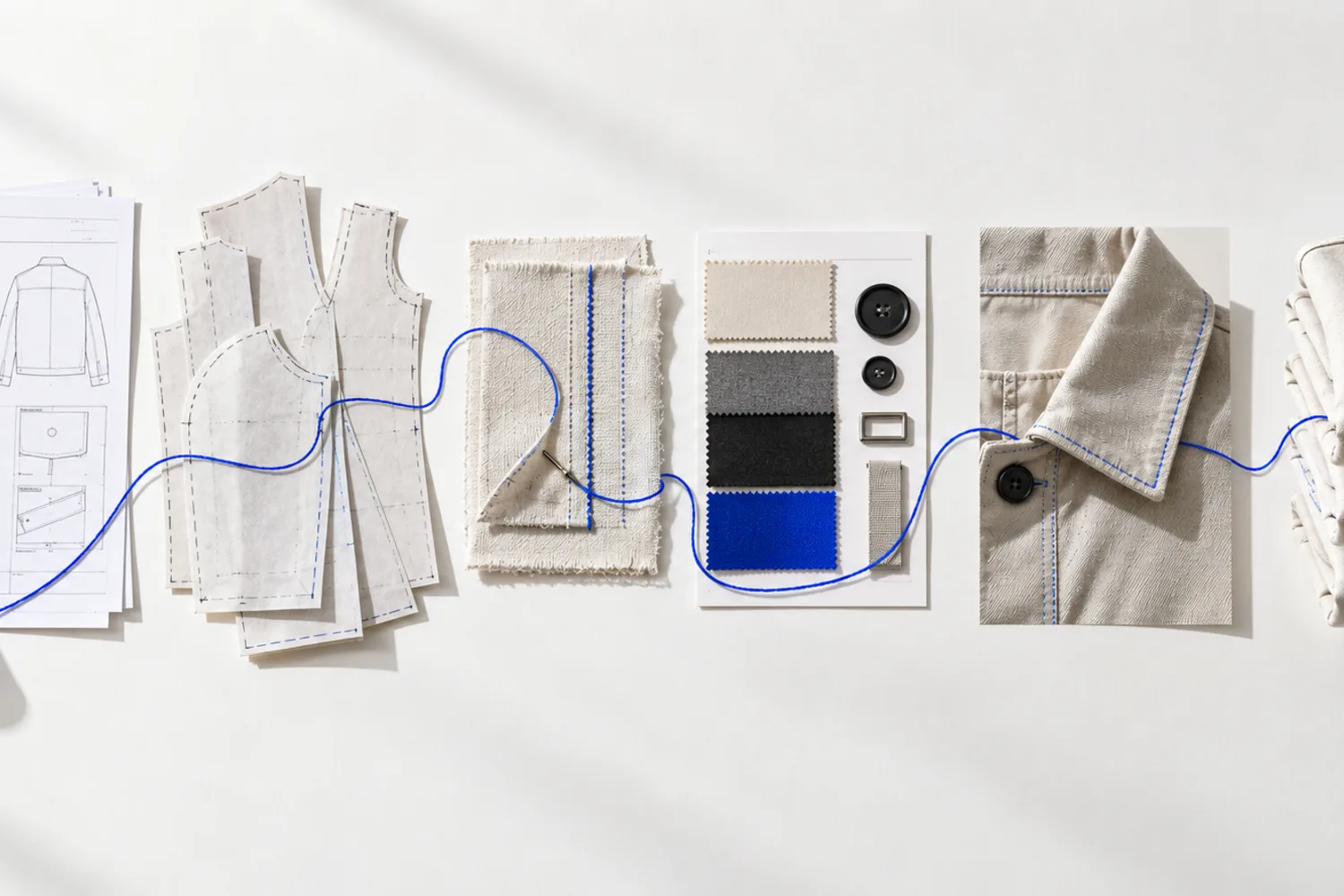
Key takeaways
- Every document needs a version and one owner.
- Costing must be updated when construction or material changes.
- Bulk should start only after the pre-production sample and production specification agree.
- An approved appearance is not the same as approved measurements, workmanship and packaging.
The production gates
| Gate | Required output | Do not proceed when |
|---|---|---|
| Technical review | Factory questions, feasibility notes, provisional route | Construction is impossible or ambiguous |
| Initial costing | Material, labour, trims, packaging and assumptions | Quote excludes critical components |
| Prototype / first sample | Construction and proportion validation | Major design decisions remain open |
| Fit sample | Approved measurements and fit comments | Comments conflict or lack priorities |
| Size set | Grade validation across key sizes | Only base size has been checked |
| Pre-production sample | Final bulk material, trims, workmanship and labels | Substitute inputs are still expected |
| Bulk start | Signed PO, BOM, tolerances, packaging and QC plan | Documents disagree with approved sample |
| Top of production / inline check | Evidence the line reproduces the standard | Early units show systematic defects |
What the tech pack must control
The document should define product identity, drawings, construction callouts, bill of materials, measurements and tolerances, grade rules, artwork, labels, colourways, packing and revision history.
A useful callout describes the result and location. It should not assume the factory will infer stitch type, reinforcement, orientation or finished dimension from a sketch.
Keep BOM, measurements and sample aligned
Three sources commonly drift apart: the spreadsheet says one trim, the sample uses another, and the purchase order contains the old price. Before bulk, reconcile all three.
When a sample change affects consumption or operation time, recost it. Otherwise the disagreement returns later as a surcharge, quality shortcut or delivery dispute.
- Give every file a version and date.
- Record approved deviations from the tech pack.
- Attach supplier codes and colour codes to BOM items.
- Mark measurement method with diagrams where ambiguity is possible.
- Archive the sealed sample and retain a matching factory sample.
What can be approved digitally
Artwork placement, label copy and simple colour layout may be approved digitally when scale and colour limitations are explicit. Fit, hand feel, drape, wash result and footwear comfort require a physical sample.
Courier time is part of the calendar. Budget duplicate samples when teams approve in different countries.
Bulk handover checklist
- Purchase order and size/colour matrix.
- Final tech pack and measurement chart.
- Approved BOM and supplier allocation.
- Approved pre-production sample and comments closure.
- Testing status and labelling compliance.
- Packaging specification and carton assortment.
- Inspection plan, defect classification and release authority.
- Material ownership, leftovers and repeat-order plan.